Blog · Materials · Guides
3D printed cheezain kitni strong hoti hain? A Complete Understanding Guide
How strong are 3D printed parts? Layer direction, material, walls, infill and orientation explained simply, with practical advice for real-world parts.
Saturn3D team
10 August 2025 · updated 25 November 2026 · 2 min read
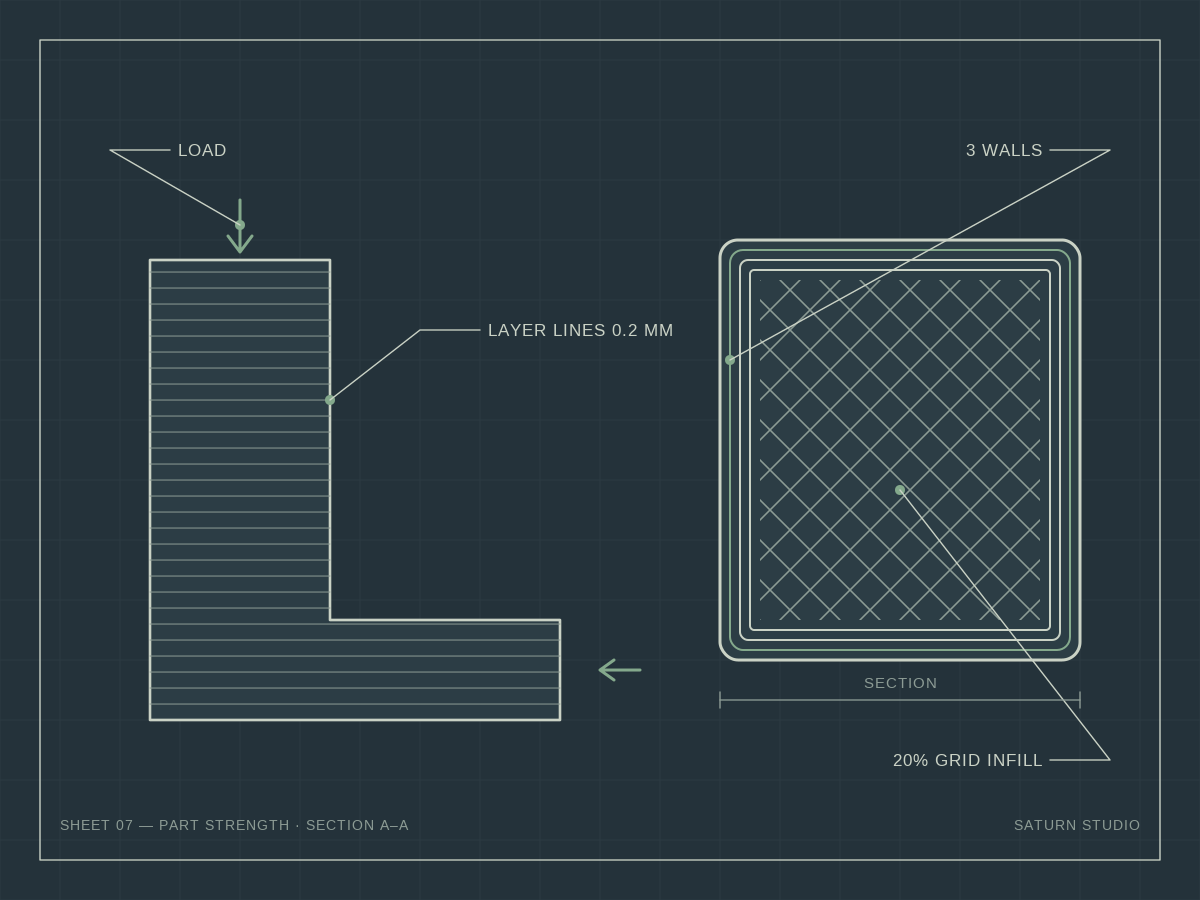
“Yeh plastic toot to nahi jaye ga?” It’s a fair question. The honest answer is: a well-designed, well-printed part is surprisingly strong — but strength isn’t a single number. It depends on a few things working together.
1. Parts are built in layers
A 3D printer builds a part one thin layer at a time, each one fused to the layer below. That means a printed part is strongest along its layers and weakest between them. Pull it in the direction that tries to peel the layers apart and it will fail sooner.
This is the single most important thing to understand, and it’s why we always ask how a part will be loaded.
2. The material
| Material | Strength | Good for | Watch out for |
|---|---|---|---|
| PLA | Stiff, strong | Models, prototypes, indoor parts | Brittle on impact, softens in a hot car |
| PETG | Tough, slightly flexible | Brackets, outdoor parts, mounts | Small details are less crisp |
| TPU | Flexible, near unbreakable | Grips, bumpers, seals, cases | Not for rigid parts |
For most functional parts, PETG is the safe choice. For things that just need to look right and stay indoors, PLA is perfect.
3. Walls matter more than infill
Most people assume more infill means a stronger part. In practice, adding walls (the solid outer shell) usually adds more strength than adding infill, because most of the stress in a part travels through its outer skin. A part with 4 walls and 20% infill is often stronger than one with 2 walls and 50% infill — and lighter and cheaper too.
Our quote tool lets you pick Light, Standard, Strong or Solid, and sets walls and infill sensibly for each.
4. Orientation
How the part sits on the print bed decides which direction the layers run. We orient parts so the main load goes across the layers, not between them, while balancing supports and surface finish. This is part of the job — you don’t need to do it yourself.
5. Your real-world use
Think about:
- Where it will live: indoors, in sunlight, near heat?
- How it’s loaded: a steady weight, repeated movement, or sudden knocks?
- What happens if it breaks: an inconvenience, or a safety problem?
For anything safety-critical, test a printed part properly before relying on it, and design with a healthy safety margin.
The short answer
3D printed parts are strong enough for robots, enclosures, brackets, jigs, mounts and thousands of everyday uses. Choose the right material, the right settings and the right orientation, and they’ll do the job. Tell us what your part is for and we’ll handle those choices — get a price or message us.